Yenagoa: Inside The Relentless Battle To Protect Nigeria’s Oil Lifeline, No sleep – Real Admiral Oladipo
By Anthonia N. Okwuolise, Abuja
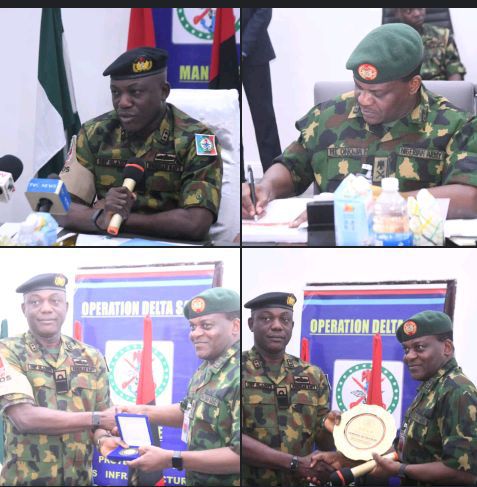
Yenagoa, Bayelsa State recently played host to a rare behind the scenes revelation of the tough and often unseen battle to protect Nigeria’s most critical economic asset. Senior military commanders have opened up on the extreme sacrifices, constant danger and non stop operations being carried out in the creeks to keep the nation’s oil production alive.
During a media tour of Operation Delta Safe, the Commander of the Joint Task Force, Rear Admiral Olugbenga Oladipo, gave a vivid account of what he described as a brutal and unending struggle against crude oil theft, pipeline vandalism and illegal refining across the Niger Delta.
According to him, the fight to secure oil facilities has demanded total commitment from troops, with officers and men operating without rest for months.
He disclosed that until December 24, there was practically no sleep for personnel under his command. Day and night merged into one, as operations continued without pause to prevent criminal networks from crippling national oil output.
Rear Admiral Oladipo explained that the intense pressure eventually paid off. The Niger Delta recorded a calm and peaceful December, with no major security incidents disrupting oil activities. He credited this success to effective leadership by the Chief of Defence Staff, General Christopher Gwabin Musa, and improved cooperation and intelligence sharing among all security agencies involved in the operation.
Despite this progress, the commander was quick to warn that the struggle is far from over.
He noted that while some host communities genuinely support the military and provide useful intelligence, others sabotage security efforts by leaking information to criminals. This often allows suspects to escape before troops arrive at targeted locations.
In one recent incident, a community blocked access to an oil platform and forced production to shut down. Oladipo said the situation was quickly resolved through a combination of military presence, dialogue and mediation, preventing a wider crisis.
To manage the growing number of disputes between oil companies and host communities, Operation Delta Safe has established a Situation Room and a Mediation Centre. The commander revealed that December alone recorded the highest number of mediation cases, largely driven by tensions arising from the implementation of the Petroleum Industry Act.
More troubling, however, is the changing nature of crude oil theft.
Rear Admiral Oladipo disclosed that illegal refiners are no longer relying on open bush fires to process stolen crude. Instead, they now use chemicals to adulterate crude oil, producing low quality fuel that damages vehicles, generators and the environment. This new method also makes detection more difficult.
In response, security forces have shifted tactics and are now tracking the supply chains of these chemicals in a bid to dismantle the networks behind this dangerous innovation.
Addressing claims that the military works in favour of oil companies, the OPDS Commander was firm and clear.
He stated that his loyalty is to the Federal Government of Nigeria and the Nigerian people, not to any oil firm or community. According to him, protecting oil infrastructure is about safeguarding national interest and economic survival.
While private pipeline surveillance contracts have helped reduce theft along major pipelines, Oladipo explained that criminals have moved their operations to remote wellheads located deep within mangrove forests. These areas are extremely difficult to access and monitor, making the task even more complex.
Despite these challenges, Operation Delta Safe carries out at least two major operations every day, supported by routine patrols, to ensure that Nigeria’s oil production does not decline.
The media tour was led by the Director of Defence Media Operations, Major General Michael Onoja, who described the engagement as part of a new thinking in Nigeria’s security strategy.
He explained that the Armed Forces now recognise the media as a vital partner in national security, stressing that information management and public perception are critical elements of modern warfare.
According to him, journalists are heroes of democracy, and failure to communicate effectively at tactical levels in the past has often resulted in serious strategic consequences. He added that under General Musa, the military is committed to openness, accountability and respect for civilian oversight.
Onoja emphasised that lasting security cannot be achieved by the military alone. It requires cooperation from communities, the media and all citizens through a whole of nation approach.
As oil exploration activities increase and investors gradually return to the Niger Delta, Rear Admiral Oladipo assured that the region is safe for operations. However, he stressed that security can only be sustained if citizens take responsibility.
He reminded Nigerians that crude oil belongs to everyone and called on the public to support security efforts by sharing timely information.
Behind the quiet headlines and steady oil output, the reality in the creeks tells a deeper story of exhausted troops, changing criminal tactics and a continuous battle with no room for complacency.
The message from the Niger Delta is clear. The war to protect Nigeria’s oil lifeline is still on, and there will be no pause.