Bola Tinubu Assumes Office as Nigeria’s 16th President
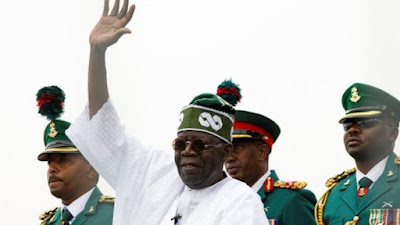
Bola Tinubu Assumes Office as Nigeria’s 16th President
… removes fuel subsidy, to revisit Naira swap policy, others
The new President of Nigeria, Asiwaju Bola Ahmed Tinubu has made several policy announcements during his inaugural address, some of which analysts described as a tough decision.
The new President made it clear that the controversial decades-long subsidy on petroleum products was being scrapped.
In his words, “fuel subsidy is gone.”
Recall that Tinubu won a disputed presidential elections in February, 2023, with a promise to renew hope.
Though he did not state clearly when the subsidy removal will become effective, however, there are reports that fuel prices are soaring across the country, with the attendant return of fuel scarcity in some parts of the country. Transport fare are also reportedly on the increase.
The above scenarios are are in response to the pronouncement of the new President on subsidy.
Already Nigerians are expecting rise in the price of petrol and that could have effect on other prices.
Previous Nigerian governments have tried and failed to end the subsidy that was first introduced in the 1970s.
But subsidy has dug a huge hole on public finances. Last year (2022), it gulped 4.3trn naira ($9.3bn; £7.5bn) and for the first half of this year, 3.36trn naira was budgeted for it, till June.
Tinubu said the subsidy could no longer be justified and that the funds would instead be spent on public infrastructure and to improve the lives of people.
President Tinubu, 71, takes over from Muhammadu Buhari, who has stepped down at the end of his two terms.
He is no doubt under pressure to fix the economy.
Inflation is at its highest rate for nearly 18 years, there is also high rate of unemployment and the output of the vital oil industry is shrinking.
He acknowledged these challenges in his speech, and vowed that his government would release its economic roadmap in the coming weeks but noted that interest rates were too high.
He won the election in February with 37% of the vote. His main rival Atiku Abubakar polled 29%, and Labour’s Peter Obi 25%.
His victory is being challenged in court by the two opposition candidates.
Tinubu said he was “spreading his hand across the political divide,” and described the election as hard-fought and of a better quality than previous ones.
He promised that women and young people would feature prominently in his administration and hinted at employing more security personnel to tackle the security crisis, which includes kidnappings for ransom.
As a former governor of Lagos, he revitalised Nigeria’s commercial hub – no easy job – and his allies say he will take the same technocratic and thoughtful approach to running the vast country of more than 200 million people.
But his opponents are of the view that the new president has lost the vitality he used to forcefully modernise Lagos.
Since the election he has travelled abroad twice, raising questions about his health. In 2021 he spent months in London being treated for an undisclosed illness.
He has brushed off the criticism, saying the job does not require the fitness of an Olympic athlete – and his associates are quick to remind everyone that US President Joe Biden is older, at 80.
… removes fuel subsidy, to revisit Naira swap policy, others
The new President of Nigeria, Asiwaju Bola Ahmed Tinubu has made several policy announcements during his inaugural address, some of which analysts described as a tough decision.
The new President made it clear that the controversial decades-long subsidy on petroleum products was being scrapped.
In his words, “fuel subsidy is gone.”
Recall that Tinubu won a disputed presidential elections in February, 2023, with a promise to renew hope.
Though he did not state clearly when the subsidy removal will become effective, however, there are reports that fuel prices are soaring across the country, with the attendant return of fuel scarcity in some parts of the country. Transport fare are also reportedly on the increase.
The above scenarios are are in response to the pronouncement of the new President on subsidy.
Already Nigerians are expecting rise in the price of petrol and that could have effect on other prices.
Previous Nigerian governments have tried and failed to end the subsidy that was first introduced in the 1970s.
But subsidy has dug a huge hole on public finances. Last year (2022), it gulped 4.3trn naira ($9.3bn; £7.5bn) and for the first half of this year, 3.36trn naira was budgeted for it, till June.
Tinubu said the subsidy could no longer be justified and that the funds would instead be spent on public infrastructure and to improve the lives of people.
President Tinubu, 71, takes over from Muhammadu Buhari, who has stepped down at the end of his two terms.
He is no doubt under pressure to fix the economy.
Inflation is at its highest rate for nearly 18 years, there is also high rate of unemployment and the output of the vital oil industry is shrinking.
He acknowledged these challenges in his speech, and vowed that his government would release its economic roadmap in the coming weeks but noted that interest rates were too high.
He won the election in February with 37% of the vote. His main rival Atiku Abubakar polled 29%, and Labour’s Peter Obi 25%.
His victory is being challenged in court by the two opposition candidates.
Tinubu said he was “spreading his hand across the political divide,” and described the election as hard-fought and of a better quality than previous ones.
He promised that women and young people would feature prominently in his administration and hinted at employing more security personnel to tackle the security crisis, which includes kidnappings for ransom.
As a former governor of Lagos, he revitalised Nigeria’s commercial hub – no easy job – and his allies say he will take the same technocratic and thoughtful approach to running the vast country of more than 200 million people.
But his opponents are of the view that the new president has lost the vitality he used to forcefully modernise Lagos.
Since the election he has travelled abroad twice, raising questions about his health. In 2021 he spent months in London being treated for an undisclosed illness.
He has brushed off the criticism, saying the job does not require the fitness of an Olympic athlete – and his associates are quick to remind everyone that US President Joe Biden is older, at 80.